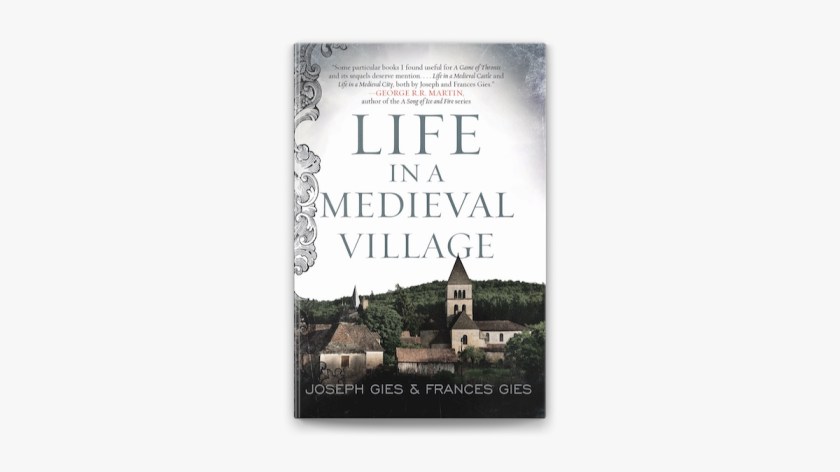
I just finished reading through a booked called “Life in a Medieval Village” by Frances and Joseph Gies. In it, they go through several chapters about English village life between the years 500-1500 AD, and using a specific town, Elton, as a continuous case study. I found a ton of great information in it, for the purposes of worldbuilding in a D&D or other fantasy setting.
I’m going to put down the notes that I found most interesting, but I definitely recommend you check it out yourself, because what I want to add to my worldbuilding is likely to be different from what you add to yours. For instance, nothing in the Marriage and Family chapter jumped out to me, but you might find it fascinating.
This is not a paid ad.
Prologue
- Elton, the example village, today has 600 people living there.
- In the Dungeon Master’s Guide, it has different size settlements, with the smallest being a village, listed as up to 1,000 people.
- Medieval villages were constantly rebuilt.
- I have a tendency to imagine villages as being static, the same one generation to the next, but even in small towns of the modern world, there is always someone making an improvement to their house, some drive thru restaurant that is changing to another drive thru restaurant. Maybe if you return to a town, the tavern could change name and management, through no nefarious means, just as a fact of time passing.
- Not to mention that wooden buildings just don’t last as long as the resources we use today.
The Village Emerges
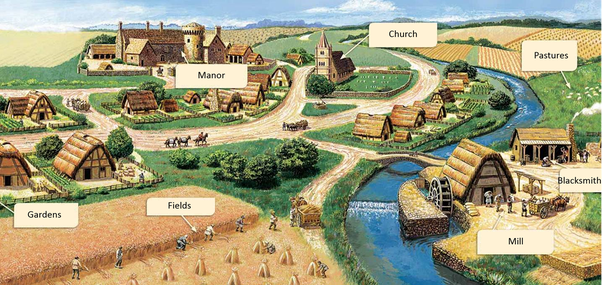
- The village population consisted of the farmers, with their houses, barns, and shed clustered at it’s center, while their fields and pastures and meadows surrounded it.
- This statement is in contrast to the American homestead of a single house, way outside of town. Everyone lived in town, and the commute to work was going out of town, to the open fields.
- The villages of England centered around the church and the manor house (of their local lord) where water was available from springs or streams.
- A village is a concentration of population within a confined area, communal buildings such as the church and the castle, and the presence of craftsmen.
- If there’s a town without a church or castle, why are they there?
- The manor is usually defined as an estate held by a lord, comprising a demesne directly exploited by the lord, and peasant holdings from which he collected rents and fees.
- Hamlets were often simply pioneering settlements established in the course of agricultural expansion, simpler and more embryonic.
- A town that’s too small was not something that normally happened. You needed a minimum number of people to be (relatively) self sufficient. It’s not enough to just have food. You need various craftsmen, otherwise you are constantly traveling to another town (by foot!) to get the basic necessities.
- Again, the American homestead seemed to require a level of technology that just didn’t exist then.
- Fencing and hedging were minimized, farmers shared the same meadow for all the town’s livestock.
- This also helps in keeping everything closer to the center of town.
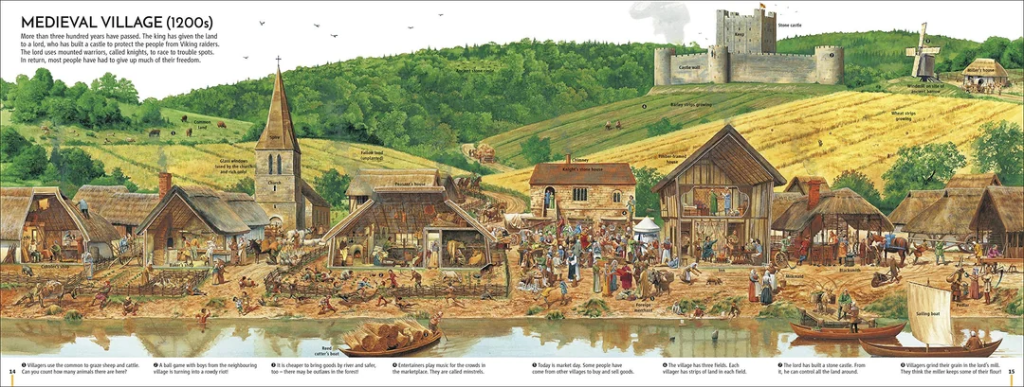
- One of the two main house types that dominated the landscape was a timber-framed longhouse, where the people would live on one side, and in winter the animals were brought into the other, with no separation but a manure trench. This not only kept the animals from freezing to death, but they contributed body heat to the house as well.
- A lord granted land to a vassal in return for military and other services; lord and vassal swore reciprocal oaths, of protection by the lord, loyalty by the vassal; the vassal received a conditional gift of land to hold and draw revenue from.
- I’ll give you some of my land, so you can be your own landlord (literally). In return, if I’m in a battle with someone, you’ll show up and fight for me.
- This is feudalism, the trade of land for battle. The fact that peasants serve on the land and serve the lord is actually part of the manorial system.
- Villages began flourishing, until everywhere villages began to crowd up against each other.
- Every spring, villages had “gang-days” where the town walks the entire perimeter of their land, and playfully dunking the children in the rivers or climbing the rocks and trees of their borders. This fun memories help establish a personal understanding of exactly where they are welcome to hunt and gather on their lord’s lands.
- In the Mediterranean area the village typically clustered around a castle, on a hilltop, surrounded by its own wall, with fields, vineyards, and animal enclosures in the plain below.
- The peoples of Germany never live in cities and will not even have their houses adjoining. They dwell apart, scattered here and there, wherever a spring, field, or grove takes their fancy.
- So if you want a town to be like this, you can, but they are culturally different. A town of scattered houses probably won’t be in the same barony as one with a central commercial hub.
The English Village: Elton
- The village was a place of bustle, clutter, smells, disrepair, and dust, or in much of the year mud. It was far from silent. Sermons mention many village sounds: the squeal of cartwheels, the crying of babies, the bawling of hogs being butchered, the shouts of peddler and tinker, the ringing of church bells, the hissing of geese, the thwack of the flail in threshing time. To these one might add the voices of the villagers, the rooster’s crow, the dog’s bark, and other animal sounds, the clop of cart horses, the ring of the smith’s hammer, and the splash of the miller’s great waterwheel.
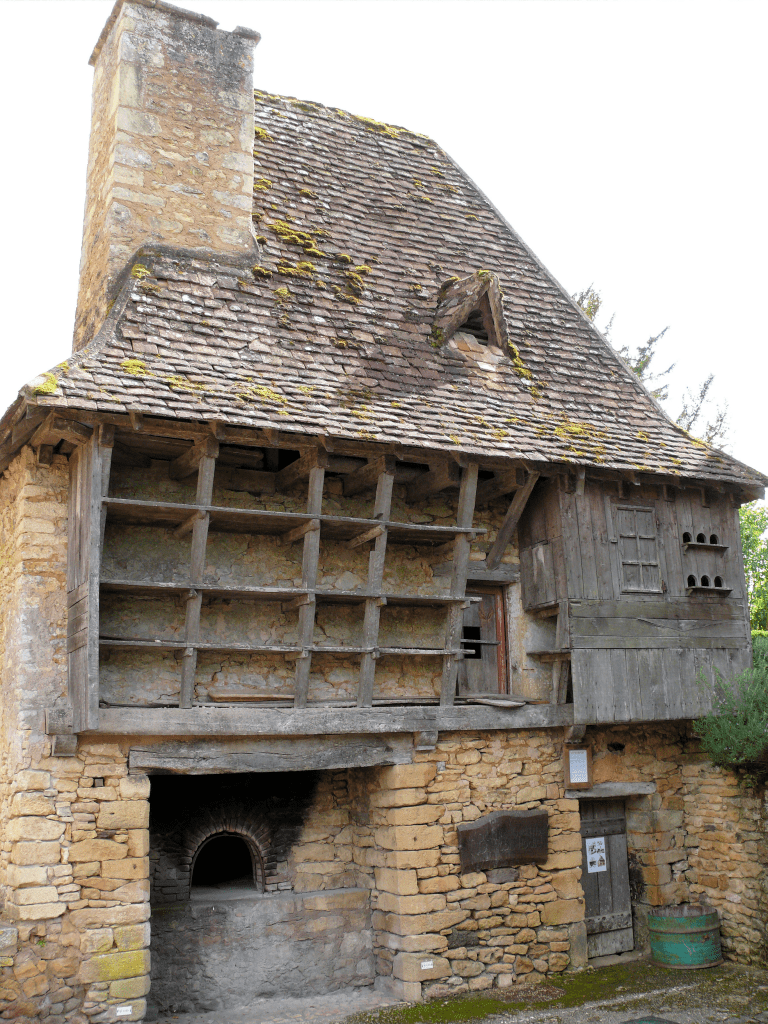
- Kitchen and bakehouse were in separate buildings nearby.
- These aren’t just separate from the house, these were essentially communal spaces. Someone’s job in town was to cook, or to bake. A family would show up with their food, prepped and dished, to be placed in the oven, and would return to pick it up after. This doesn’t seem like it was a daily process, but instead for special meals that you’re willing to put in the extra time and effort for.
- The ovens were leased from the lord by a baker. A forge was leased by a smith who worked for both the lord and the tenants.
- Ealdorman is a royal official.
- I also like the Alderman from The Witcher, so I’ve added this to my hierarchy of nobility. In modern life, there are towns that are too small to have their own mayors. I’m using that as a framework, where a town is too small to have a Baron, they instead have an assigned official that essentially just collects taxes and communicates between the Baron and the peasants.
- Town names with the suffix of -tun or -ton means village, whereas the suffix -inga indicates the followers or kinsmen of a leader.
- The Village of the People of Aethelheah became Aethelington, then Ailington, then became Elton in the modern day.
- Danish suffixes include -thorpe for village, -toft for homestead, and -holm for water meadow.
- In a conversation about one noble purchasing an entire village over to another, it was sold for “fifty golden marks”.
- I don’t know how much a mark is, but I do know that in D&D 5e a potion of healing is 50g.
- Later, they say that Elton came to belong to Ramsey Abbey, designed for the monks’ support.
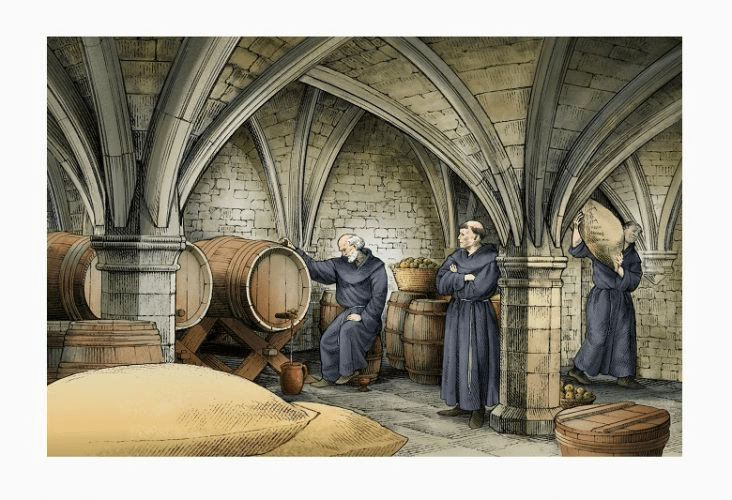
- Religious abbeys and monasteries owned land, which they often used to grow grapes to make and sell wine. In this instance they owned an entire village, much like a noble lord would, and took payment from rent as a way to support their religious work.
- Churches were common, if not universal, village features.
- After military service, the lack of clear-cut military tenures encouraged knights to settle illegally on abbey lands.
- This isn’t just moving into a house, this is essentially claiming ownership of an entire village if it doesn’t have it’s own local lord, as is just managed by the Church.
- This was illegal, and if pursued through the court system, was reversed and the knight was punished.
- A fundamental Norman legal principle was “No land without lord,” meaning every piece of land was owned by someone.
- Of the villagers in a village, some where free, some semi-free, and some servile.
- There are three elements of villages, in overlapping categories. Public space, where everyone, including outsiders has rights, such as highways, streets, and lanes. Communal space, where all inhabitants have rights, such as the green, the oven, the pond, the wells, the stocks, and the open fields. And private space, where access and use are open only to the proper individuals, the manor house, the tofts and crofts of the peasants. The Church is public, and communal, and private. The smithy are both communal and private.
- In D&D, adventurers have a tendency to walk around wherever they please, excluding people’s homes. But the idea that some places are open for the locals but not to outsiders could add some interesting dimension to a setting.
- Village streets appear after the homes. People’s homes were made, then people walked between them enough that paths were worn down. The village network was more path than street.
- Elton village officials and ordinary villagers both traveled to fairs and markets to make purchases and sell their produce.
- The outside world came to Elton (a small village) by way of monks, churchmen, nobles, craftsmen, day laborers, and royal officials.
The Lord
- Every village had a lord, but only rarely was he in residence. A resident lord was usually a petty knight who held only one manor.
- For the non-resident lord, they had a steward, usually a knight, who appeared in each village no more than two or three times a year, for no more than two days at a time.
- The lord’s deputy the rest of the time was the bailiff, a member of a better-off peasant family (not nobility). Chief law officer, protector of the village against men of another lord, and seeing that crops and stock were looked after and not stolen. They were paid an excellent cash salary, plus room and board, a fur coat, fodder for his horse, and the money necessary for his Christmas offering.
- I have combined this role with the Alderman listed above for my Human Kingdom.
- Assisting the bailiff was the reeve, who’s job was to see that the villagers who owed labor service rose promptly and reported for work, as well as collecting rents.
- Again, I’ve made the Alderman take these roles. In the real world this is clearly too much work for one person, but in a world designed to engage adventure stories, you don’t want too many government officials, because then it becomes unclear who the players should engage with.
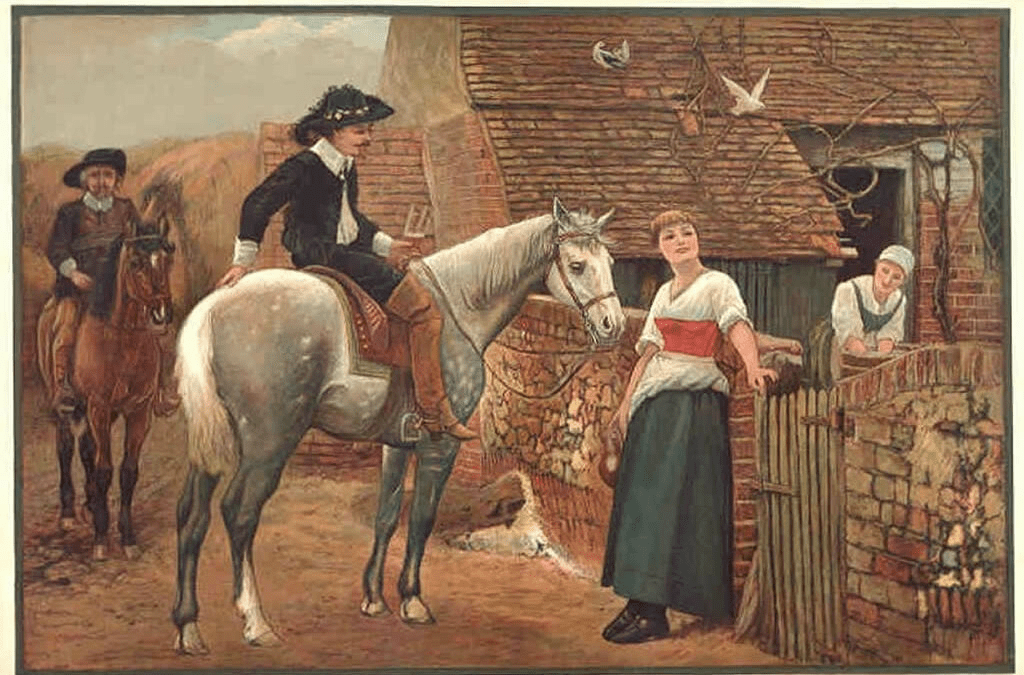
- Lords assigned quotas of wheat, produce, lambs, eggs, and more to produce for sale. Any shortfall was to be paid out by the reeve, but these quotas were low enough that the reeve probably made a profit most years. Monks would set more moderate quotas, but be more strict about them.
- The lord had an important, centuries-old judicial function, dealing in a range of civil and criminal cases that provided him with fines, fees, and confiscations. There were dues for death, inheritance, and marriage. He also had a monopoly on grinding grain and baking bread, which as we learned above, was done through specific communal individuals.
- The very yardstick of a lords prestige was the number of people he fed, staff, armed retainers, labor force, and guests.
- One of the lords most valuable privileges was the right to license markets and fairs.
- During the harvest season of late autumn, every villager, save the lord himself, was expected to be out in the field cutting, stacking, carting, threshing, and storing the wheat before the first winter’s frost.
The Villagers: Who They Were
- Economic strength was a bigger class delineation than actual legal class. A rich villein (serf) was a bigger man in the village than a poor free man.
- In addition to wealth and legal status, one’s place in the community was equally important to their social standing. Villagers chose who was the reeve, juror, head of tithing, and ale taster (unironically a very important job).
The Villagers: How They Lived
- All the village houses were a hall, a single high-ceilinged room with a number of bays, each about 15 square feet. A rich villager might have four or five bays, plus the entry. There was also a second story above the service rooms for sleeping, like a loft. A mid-level peasant probably had a three-bay house. In the center was a fireplace on a raised stone hearth and vented through a hole in the roof.
- Hams, bags, and baskets hung from the rafters to be away from rats.
- Breakfast is usually bread and cheese, while lunch is meat or fish. Every meal, including breakfast, was washed down with ale.
- Fruit was cooked, as raw fruit was thought unhealthy.
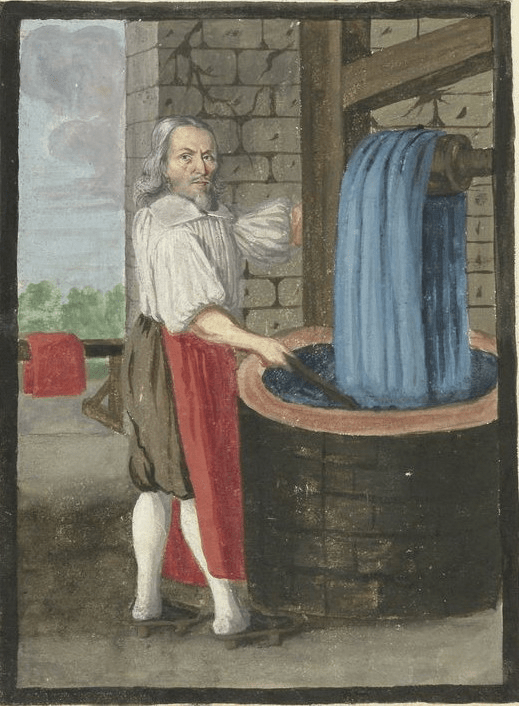
- Peasant clothes weren’t drab gray, they were bright blues, red, and greens. One of the jobs in town is a dyer, who dyes your clothes whatever color you want.
The Village At Work
- As mentioned above, the baker was a single person, and their monopoly was guarded by the court. In fact, the book talks about three villagers who were fined, just for “going into the baking business.” Again, the baking oven was leased by the lord, so they needed to ensure the baker got all the business in town.
- Ale brewing was everywhere, because weak ale was safer to drink than well water. After you make a batch of ale, you put a sign at the front of your house, and your house is the town’s tavern while supplies last. It was also an official job to be an ale taster, to make sure you weren’t making gross ale and giving it to people. Almost like a modern health inspector.
- One of the hardest jobs was mowing, so some lords gave the mowers a bonus sheep to roast.
- There was a lot of specialized work, but one town can’t support the worker. So instead it was a common career to go from town to town, do all the work of your specialty needed, and move onto the next. That means there is always some handyman in town, and your projects would sit around and wait for them to show up.
- Shoemaker, clothing tailor, stone removal, floor tiler, roof thatcher, animal branding, saddle maker, brass jar and pan repair, diver, slater, malt drying, etc.
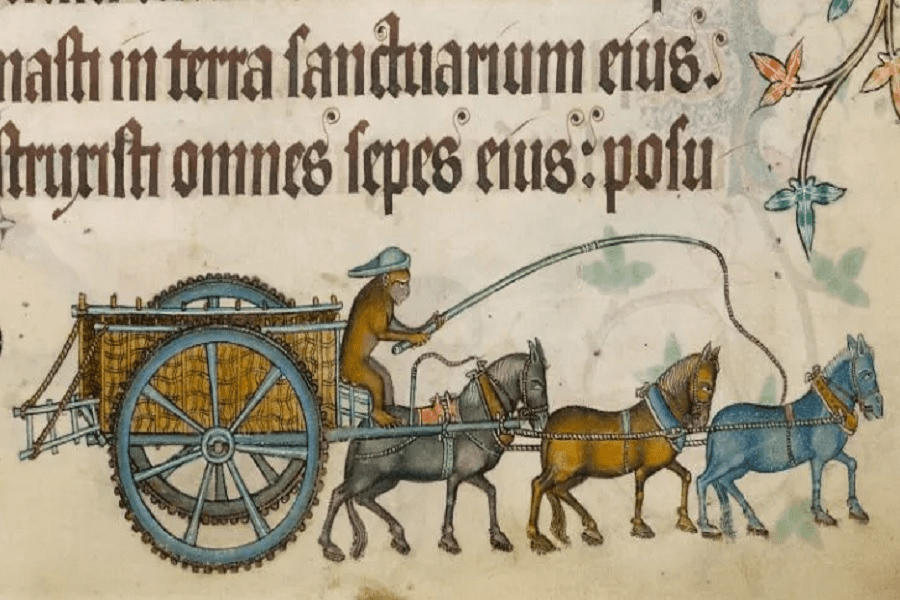
- From August 1 to September 8 it’s expected you spend three days a week in the field.
- From September 8 to September 29, it’s expected you spend five days a week in the field.
- From September 29 all the way to August 1 of the next year, it’s expected you spend about 2 days a week in the field.
- The lord didn’t rule without pushback. Protests and minor riots are record at numerous places.
The Parish
- It was often hard to get people to go to church, coming up with the same excuses we use today. “It’s too cold out, I’m not feeling well, etc.”
- When they did go, they would be chatting, gossiping, or flirting. People were leaning against a wall or pillar, not standing and kneeling or paying attention.
- Just as with all skills, there were better preachers than others, and there were some that would go from town to town, just like the craftsmen above, and give a much more interesting sermon for the week.
- Some villages had more than one church. Usually ones that have more than one manor.
- Remember that each village has their local lord, but also several layers of nobility above them, and many have a manor in multiple subdivisions. Meaning there have to be places where there are multiple lords all living near each other, each with their own house staff, meaning there is a larger population, and thus a larger need for churches.
- Also remember that religious diversity was non-existent. The only religion allowed was Catholicism.
- This is unlike ancient Romans, who instead worshiped at private altars in their own homes.
- In my setting, there are High Gods, as well as Lesser Gods and Saints. So you go to the local temple/church to hear a sermon about the High Gods, but then you have private altars to your preferred Saint or Lesser God.
- The main way the church was paid was via tithing, or giving them 1/10 of what you made. Today that’s almost exclusively in the form of money, but then it might be one tithe of crops, wool, milk, maybe stone. The church’s clergy were then in the business of turning these raw materials into sellable goods.
- The churchyard was walled, with the walls kept in good shape, to ensure animals don’t come in the night to dig up and eat the corpses.
- In a list of required furnishings for a church, they don’t list benches, chairs, or pews. Instead the congregation stood, sat on the floor, or brought stools.
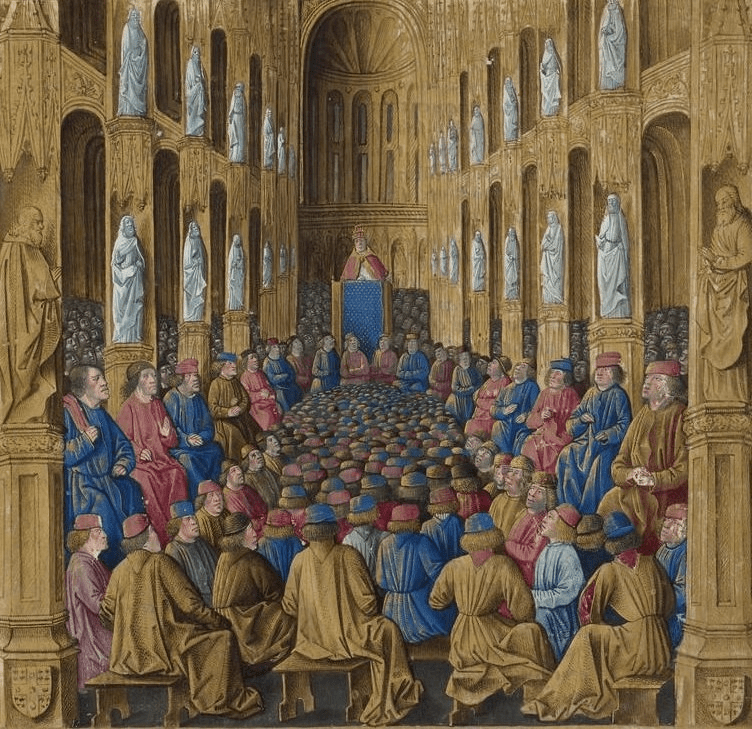
- Everyone who entered the clergy made a vow of chastity, but almost none observed it. Some priests were married, but concubinage, living with a romantic partner without being married, was more common. There’s even a story about a woman who “lived with” a priest and then had four sons, three of which became priests themselves.
Village Justice
- There were three types of courts. Manorial, Church, and Royal.
- Royal Court were run via travelling judges, again just like the priests and the tradespeople above. They focused on felonies, like homicide, rape, larceny, burglary, arson, and treason. These travelling judges were often Knights, who would examine the body, and question neighbors and witnesses. Full on detective work. The guilty punishment was often the death penalty.
- Manorial Court was taken care of by the local lord, and focused on trespassing, assault, breaking and entering, theft, abduction, extortion, or threating violence. A guilty punishment was often a fine.
- Church Court was limited to clergy and dealing with moral or marital problems. Because Church Court handled anything related to the clergy, some criminals would become clergymen while waiting for their trial, getting them out of Royal Court. A guilty punishment was often a penance and pilgrimage.
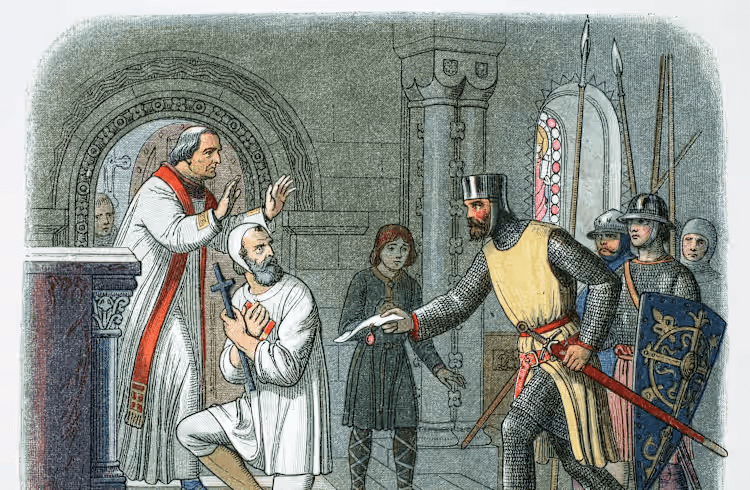
- If you were running from law enforcement, and ran into a church, it acted as a one-time Get Out of Jail Free card. You had to confess and surrender, but then the Church protected you for up to 40 days. Usually at that point the Knight-Detective would just exile you from the country.
- Non-violent crimes were rarely punished via imprisonment or corporal punishment. Maybe assault would land you in the stocks.
- By 1215, trial by combat or trial by drowning or burning were seen as archaic.
- The court record was kept on a long strip of parchment, eight inches wide, and stitched from end to end, to make it a massively long scroll.
- If someone needed to take out a loan, they would do so by pawning their belongings. There were no references to loaning money itself, but pawning was very common.
The Passing of the Medieval Village
- During the Black Death, mills were broken and useless, common ovens were abandoned, and smithies were collapsing.
- Some people made a living as freelancing farmers, going into a town, charging high rates to get the farm work caught up, and leaving to the next.
- Then the Hundred Years War caused taxes to rise an insane amount.
Final Thoughts
Throughout this whole book, there are really two thing that continued to surprise me.
One was just how much they were just like us. Stories and media always like to represent it as a completely unfamiliar way of life, but they skipped church, they liked their clothes to be in bright colors and paid someone to do that for them, they would make their favorite dishes and get them cooked or baked. It was not a life of drab work and mud, while the lords ate huge feasts and ruled with fury.
The other is just how many people were constantly visiting towns for some specialized purpose. The people that stayed in town were farmers, smiths, and bakers. Otherwise almost every skilled job was done by people that would make the rounds, charging what they wanted, and you never knew who was going to show up this week. It is a fully valid career choice to be a travelling stone remover. You could make a slice-of-life anime about a quiet town with a new travelling character each episode that shows up and stirs up gossip and drama.
This is only one in a three-part series, the other two being Life in a Medieval City and Life in a Medieval Castle, which I intend to get and make similar articles here for you to use and inspire.


YEEEEEEESSS my show is on!!!!
Awesome article! I love the medieval time period, I’ll keep an eye out for your summaries on the other 2 books.
I am pleasantly surprised by how lax church seemingly was. I’m used to colonial puritans where if you skip church or had an affair or something you were punished for it.
Xoxo gossip girl
LikeLike